
FERRO 2026: Key Highlights and Hafnia Ferroelectric Insights
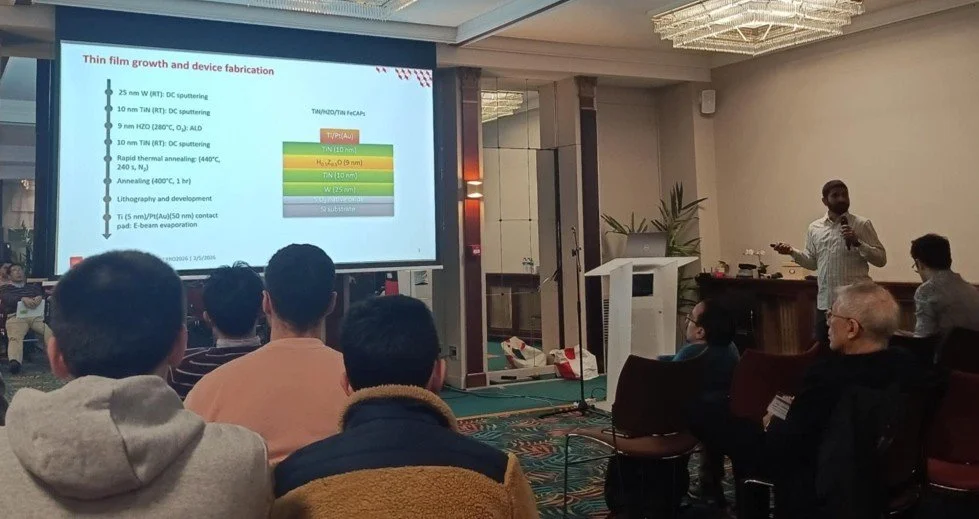
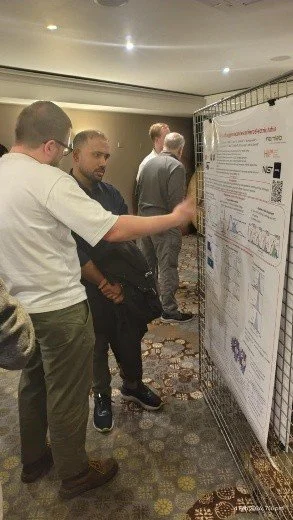
More than 130 scientists took part in the 2026 edition of the 37th annual workshop on Fundamental Physics of Ferroelectric, in Tours, France from 2nd-5th February. 58 oral and 56 poster presentations covered a wide range on the physics of ferroelectricity and related phenomenon, with both experimental and theoretical approaches.
The hafnia community was well represented, with a dedicated section highlighted by an invited talk from Alireza Kashir (Ferroelectric Memory GmbH), who presented “20 Years of Ferroelectric Hafnium Oxide: A Review of its Physics and an Outlook for Advanced Memory.” This talk provided a comprehensive review of the current status of hafnia-based memory devices and their future perspectives.
Interestingly, several theory-focused presentations emphasized hafnia, highlighting the ongoing and urgent need for a deeper theoretical understanding of switching mechanisms and phase stability in this material. Key contributions included talks by Ronald Cohen (Carnegie Institution for Science), “Pathologies of the Polarization Lattice: Switching in Hafnia”; Claudio Cazorla (Universitat Politècnica de Catalunya), “Finite-Temperature Phase Competition in Bulk HfO₂ from First-Principles Anharmonic Free-Energy Calculations”; and Binayak Mukherjee (University of Liège), “The Polarization of Hafnia Ferroelectrics Is Not a Bulk Property.”
Ferro4EdgeAI was well represented by the LENSIS Lab through contributions from Somnath Kale and Tom Iung, with one oral and one poster presentation. Somnath Kale presented an oral contribution entitled “Multilevel Polarization Switching in Ferroelectric Hafnia Thin Films and Devices.” Tom Iung presented a poster on previously published work (J. Appl. Phys. 138, 134106 (2025)) carried out within the Ferro4EdgeAI framework on “Correct Quantification of Oxygen Vacancies in Ferroelectric Hafnia.”