
Ferro4EdgeAI present at the E-MRS 2026 Fall Meeting
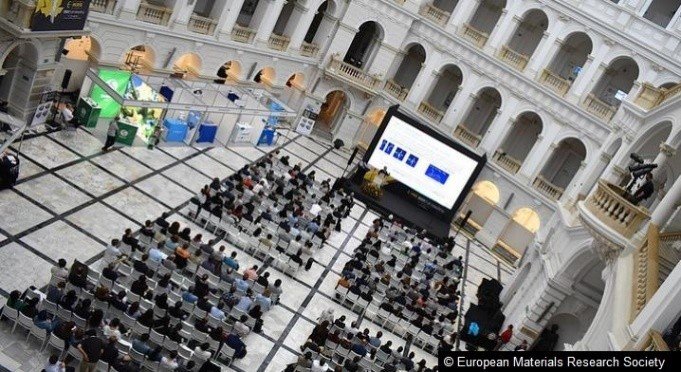
Consortium partners from the Ferro4EdgeAI project hosted the Symposium K: Ferroelectric Materials and Devices for Next-Generation Computing at the recent E-MRS 2026 Fall Meeting in Warsaw, Poland with great success.
OUTREACH ON THE RUN
This past 14th to 17th of September, the 2026 E-MRS Fall Meeting took place in Warsaw, Poland. Hosted by Warsaw University of Technology, the meeting featured 25 symposia covering a wide range of topics, including materials for electronics, optoelectronics and biomaterials, as well as materials modelling and characterization.
Partners of the Ferro4EdgeAI consortium had the privilege of organizing and hosting Symposium K: Ferroelectric Materials and Devices for Next-Generation Computing, which brought together materials scientists, physicists and device engineers to discuss how ferroelectric materials can enable new memory technologies, neuromorphic computing and low-power edge AI. Over one and a half days, the programme featured three invited lectures, ten contributed talks and a poster session, with participants from across Europe as well as the USA, Japan and India.
Beyond Hafnia
The symposium opened with an invited lecture by Deep Jariwala (University of Pennsylvania) on III-nitride ferroelectrics for low-power computing. His presentation highlighted the progress made in these materials, particularly wurtzite nitrides such as AlScN, and their potential for future applications, including extreme operating environments. Other contributions explored multiferroic rare-earth vanadates, the use of the ferroelectric semiconductor ErMnO₃ for photocurrent-based reservoir computing, and hybrid organic-inorganic ferroelectrics, illustrating the growing diversity of materials under investigation.
From materials to devices
On the second day, Luís Marques (University of Minho) presented an invited overview of ferroelectric binary oxides for low-power memory and neuromorphic devices. Other talks focused on improving hafnium zirconium oxide (HZO) through doping, precise control of material composition and the design of ferroelectric/antiferroelectric layers to reduce the voltage required for switching.
Reliability is key
Reliability emerged as a central theme. In his invited talk, Zhenhong Liu from the group of Kasidit Toprasertpong (University of Tokyo) presented a charge-injection-based framework offering a unified picture of imprint, wake-up and fatigue in HZO capacitors, a topic echoed by work on fatigue and interface traps in thin HZO gate stacks. Device-oriented contributions covered analog ferroelectric switching for neuromorphic computing, the thermal stability of ferroelectric transistors, solution-processed films, and epitaxial heterostructures combining electrostriction and ferroelectricity.
MOVING FORWARD
The discussions highlighted the importance of improving reliability and interfaces while linking the fundamental properties of materials to device performance. The symposium fostered valuable exchanges between the materials and device communities, including partners of the EE Ferro4EdgeAI project. The organizers warmly thank all speakers, participants and the E-MRS team and look forward to continuing these discussions at future E-MRS meetings.