
High-k Workshop: 20 Years of Ferroelectric Doped HfO₂
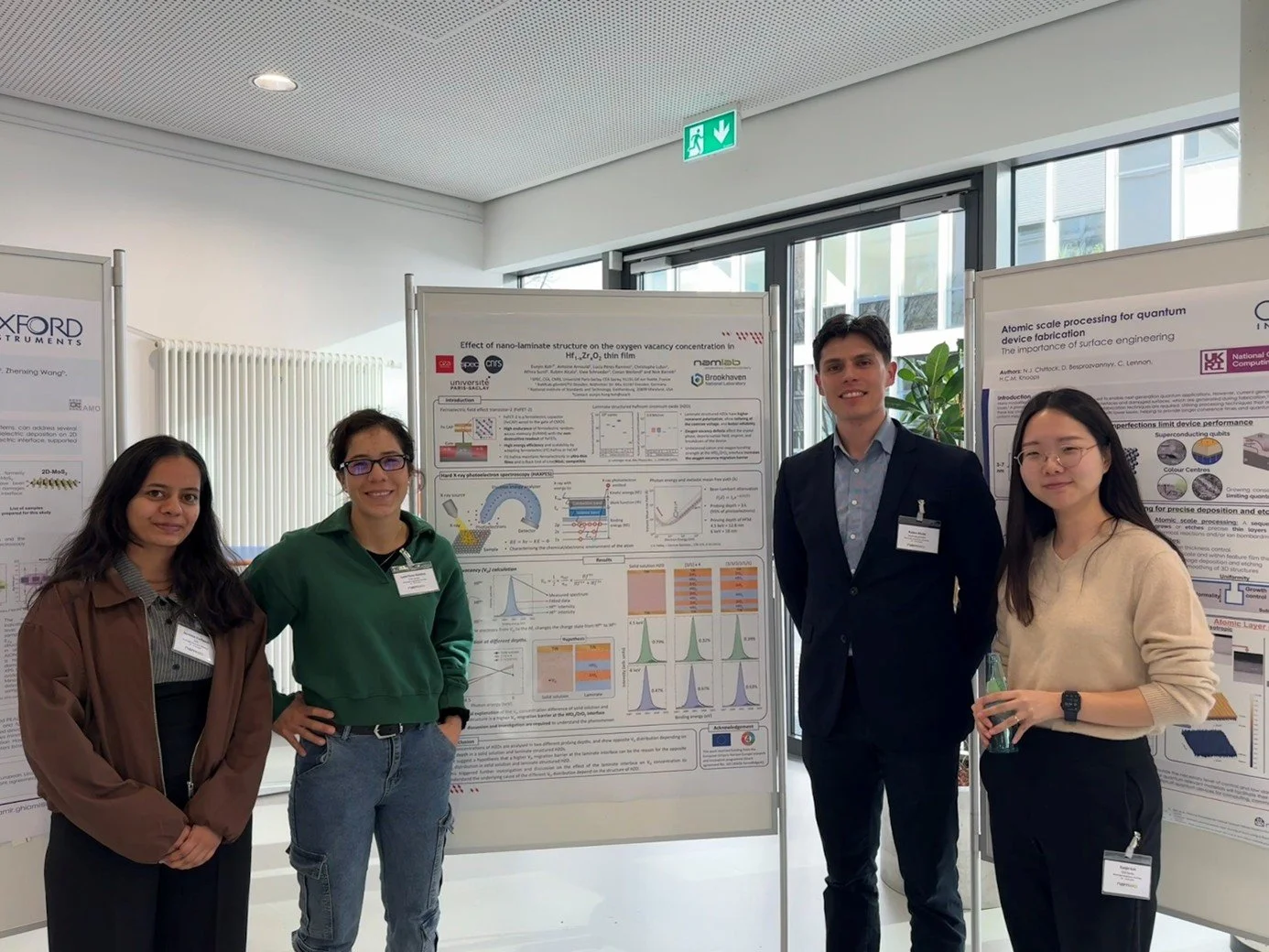
Jayshree Dadheech, Lucía Pérez Ramírez, Ruben Alcala, and Eun Jin Koh, in front of Eun Jin’s poster.
The Novel High-k Workshop was held from March 24 to 26 at NaMLab in Dresden, Germany. The 20th anniversary of the discovery of ferroelectric doped HfO₂ was celebrated with 36 oral presentations, ranging from theoretical and experimental studies on ferroelectricity in HfO₂ to device applications of ferroelectric doped HfO₂.
At the workshop, Tim Böscke (ams OSRAM, Germany) opened the session with a talk on the historical starting point of ferroelectric HfO₂, titled “How Everything Started at Qimonda.” Jorge Íñiguez-González (LIST, Luxembourg) delivered a presentation on theoretical research into crystal phases and polarization in “Factors Controlling the Sign of the Polarization in Hafnia Ferroelectrics.” Alexei Gruverman (University of Nebraska–Lincoln, USA) gave talks on polarization and conductivity in HfO₂ and AlScN: “Nanoscale Insight into the Ferroelectric and Piezoelectric Properties of HfO₂-Based Thin Films” and “Conducting Domain Walls in Ferroelectric Al₁₋ₓScₓN Thin-Film Capacitors.”
In addition to the academic sessions, a panel discussion was held with representatives from IMEC, Sony, FMC, IPMS, and GlobalFoundries on the future of HfO₂ ferroelectric devices and key outstanding challenges.
Ferro4EdgeAI was strongly represented by CEA/SPEC/LENSIS (France), CEA/LETI (France), NaMLab (Germany), and international collaborator Cheol Seong Hwang (Seoul National University, South Korea). Eun Jin Koh (LENSIS) presented a poster titled “Effect of Nanolaminate Structure on the Oxygen Vacancy Concentration in Hf₁₋ₓZrₓO₂ Thin Films,” and Jayshree Dadheech (LENSIS) presented “Impact of Ta and TaOₓ Interlayers on the Interface Chemistry of Ferroelectric Hafnium Zirconate.” Laurent Grenouillet (LETI) delivered a talk on “Transitioning from 2D to 3D Ferroelectric Capacitors in FeRAM Arrays.” Ruben Alcala and Stefan Slesazeck (NaMLab) gave oral presentations titled “Material Optimization for Improved Reliability in HZO” and “Y₂O₃-Based Ferroelectric Tunneling Junctions for In-Memory Computing Crossbar Arrays,” respectively. Cheol Seong Hwang also presented “A Journey to Ferroelectric HfO₂” and “Proximity Ferroelectricity in Stacked Hard/Soft Ferroelectric Films.”
This work is supported by the Ferro4EdgeAI project and by the FerroFutures project of PEPR Électronique (ANR-23-PEEL-0003).